This week, I read an article in the New York Times titled, “A Different Type of Dementia is Changing What’s Known About Cognitive Decline,” and it discussed a recently recognized form of dementia called LATE dementia.
LATE, which is shorthand for Limbic-predominant age-related TDP-43 encephalopathy, is currently estimated to affect a third of people 85+, and experts posit that several patients diagnosed with Alzheimer’s may actually have LATE dementia.
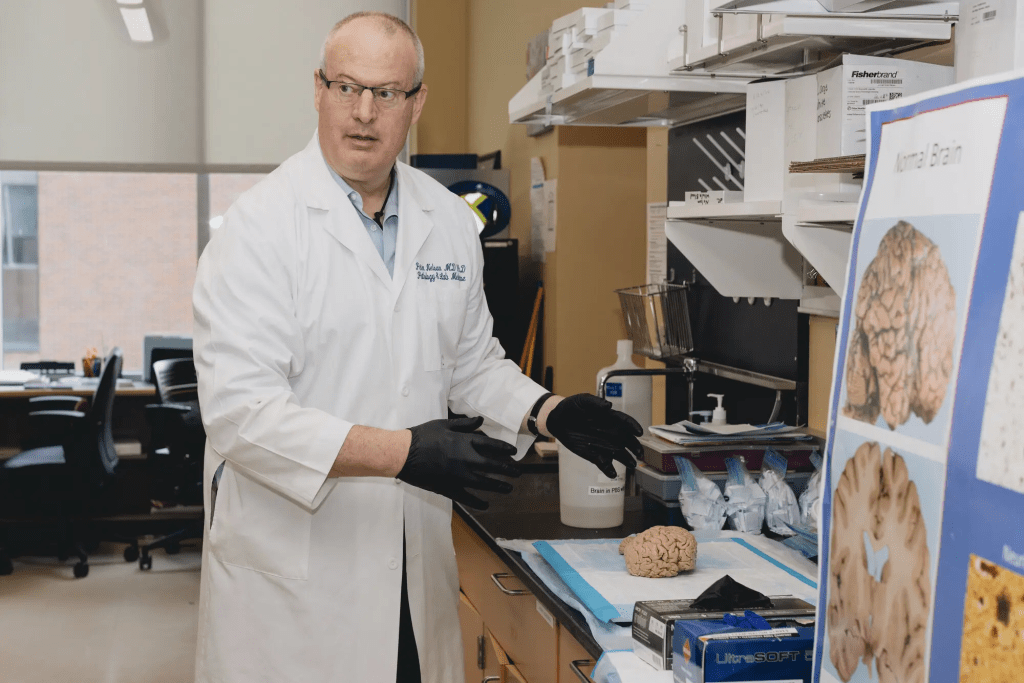
[Dr. Pete Nelson] Imag Source: The New York Times
Although LATE is generally less severe than Alzheimer’s on its own, when contracted in conjunction with Alzheimer’s, it worsens symptoms of cognitive decline and functional immobility rapidly. About half of adults older than 85 with severe Alzheimer’s also have LATE, and their symptoms, including psychosis and urinary incontinence, have been brutal and trying.
Biologically, LATE diverges from Alzheimer’s in its cerebral protein aggregation: while the buildup of amyloid-beta and tau plaques are typically associated with Alzheimer’s, the protein TDP-43 has been shown recently to be pathognomic of LATE. TDP-43 is also involved in other cognitive disorders such as amyotrophic lateral sclerosis, as well as genetic regulation of nucleic acids. In LATE, however, TDP-43 seeps out of the nucleus and forms clumps in neurons.
Because LATE cannot be effectively treated with amyloid-beta-targeting drugs, a drug called nicorandil, which treats reduced blood flow to the heart, is currently being tested to treat LATE patients. Researchers are hopeful that, since nicorandil increases blood circulation in smaller vessels, it may help prevent the hippocampus from shrinking.
Programs that emphasize interaction and connection matter more than ever in this context. Whether someone is experiencing Alzheimer’s, LATE, vascular dementia, or a combination, the evidence consistently shows that social connection improves quality of life and can slow cognitive decline. When we invest in community-building, intergenerational spaces, senior-friendly public environments, and ongoing engagement, we’re not just being kind — we’re building protective infrastructure for cognitive health.
Reading about LATE doesn’t make the dementia landscape simpler. But it does make it clearer. It reminds us that aging is not uniform, that memory loss is not destiny, and that understanding the differences between conditions can lead to better care, better planning, and more compassionate support for older adults and their families.
If we want to create an aging system that works, we have to acknowledge the full spectrum of brain changes that come with growing older — and design our communities around dignity, connection, and the rich diversity of the aging mind.


 Brains for Change
Leave a comment