This week, I came across an Instagram reel making the rounds online, claiming that a Japanese geriatric physician had identified daily handwriting as a key reason some older adults avoided cognitive decline well into their eighties. The video framed handwriting as a kind of neurological shield and suggested that something as simple as a pen on paper could shape memory across decades.
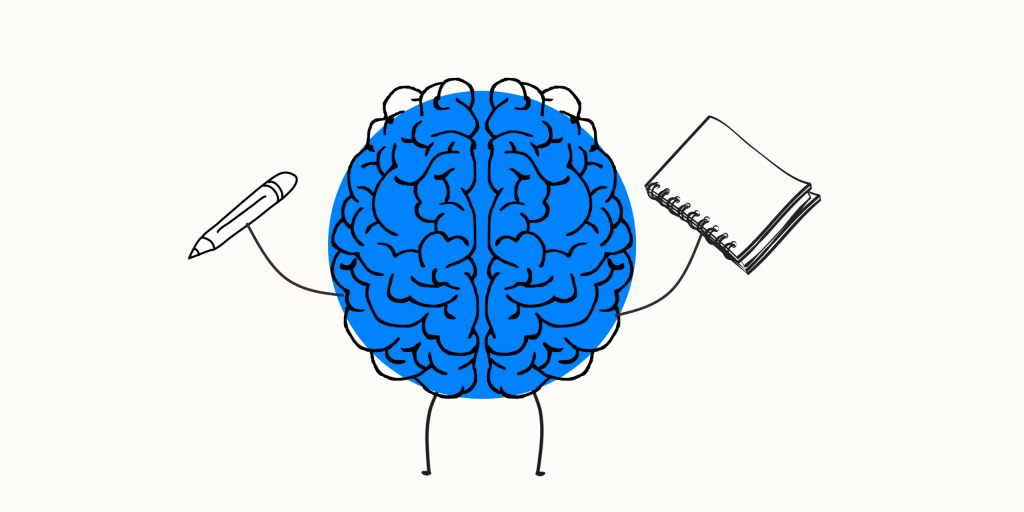
Image Source: Any.do
The reel itself was dramatic, perhaps overly so. But the underlying idea that how we engage our brains matters just as much as how often is not far-fetched. In fact, it aligns closely with what neuroscience has been telling us for years.
Handwriting is a uniquely demanding cognitive task. Unlike typing, which quickly becomes automated, writing by hand requires the brain to coordinate fine motor control, spatial planning, sensory feedback, language production, and memory encoding simultaneously. Functional imaging studies consistently show broader neural activation during handwriting than during keyboard-based tasks, particularly in regions associated with learning and memory. The brain cannot outsource the work. It has to stay awake.
This matters even more as we age. Cognitive decline is not simply about neurons disappearing; it’s about networks losing flexibility and engagement. When tasks become overly passive or repetitive, the brain adapts by doing less. But when an activity requires intention, coordination, and meaning, it helps preserve cognitive scaffolding.
What struck me most about the handwriting discussion wasn’t the pen itself, but what it represents: effortful creation. Writing forces us to slow down, to choose words deliberately, to translate abstract thought into physical action. It is not efficient, and that inefficiency is precisely the point.
This is why non-pharmacological interventions matter so deeply in aging. Creative acts like writing, music-making, storytelling, and art are not “extras.” They are forms of cognitive infrastructure. They demand participation rather than observation, agency rather than consumption. And unlike many clinical interventions, they restore something that aging too often strips away: a sense of authorship over one’s own inner life.
In dementia care, especially, the temptation is to simplify: to reduce stimulation, to minimize challenge, to prioritize safety over engagement. But the evidence increasingly suggests that appropriate challenge, when paired with support and dignity, can be protective. The brain does not benefit from being shielded from effort; it benefits from being invited into it.
Whether through handwriting, music, or shared creative expression, the lesson is the same. Cognitive health is not maintained by doing less. It is maintained by doing things that require us to show up fully: mind, body, and memory together.
Aging does not mean the brain no longer wants to work. It means it needs better reasons to.
If we want to build systems that support cognitive health across the lifespan, we have to invest not only in treatments but in meaningful engagement: the kinds of activities that remind people, at every age, that their thoughts are still worth forming slowly, deliberately, and by hand.



 Brains for Change
Leave a comment