To build on my extracurricular, volunteer, and academic work, I’ve been actively seeking opportunities to conduct independent research. These projects allow me to explore questions that connect my interests in science, policy, and community impact. Simultaneously, I am able to strengthen the skills and knowledge I bring to my other initiatives.
Innovation in Aging (Oxford University Press) & Annual Scientific Meeting Presentation (GSA)
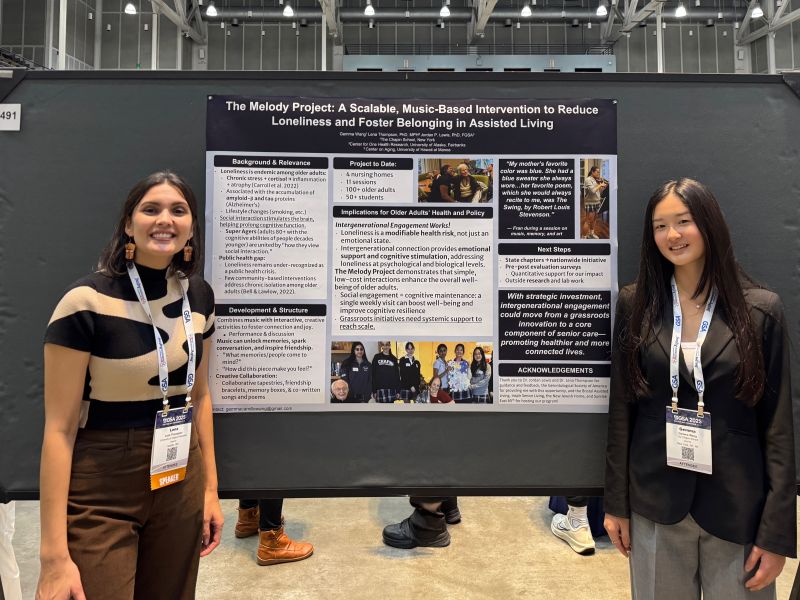
I was also inspired to submit an accepted abstract to the 2025 Gerontological Society of America (GSA) Annual Scientific Meeting, titled “The Melody Project: A Music-Based Intervention to Reduce Loneliness and Foster Belonging in Assisted Living,” published in Innovation in Aging, a publication by Oxford University Press on behalf of GSA.
The abstract synthesizes my nonprofit work and highlights the importance of community-based interventions in improving emotional well-being among older adults. I presented this work in November 2025 alongside postdoctoral researchers, professors, and scientists from across the country. Preparing for the conference challenged me to frame my experiences through a scientific lens, translating community engagement into data-driven discussion and understanding how qualitative impact can inform evidence-based practice.
Summer Research Academies
At the University of Santa Barbara California’s Summer Research Academies, I worked with a research group to develop a research paper and project investigating whether tRNA methylation by the methyltransferase gene nsun-4 affects the role of mt tRFs as mtDNA heteroplasmy indicators.

There is an urgent need for improved strategies and treatments to address cognitive decline, as nearly 6.9 million Americans over the age of 65 currently live with neurodegenerative diseases. One key biological contributor to neurodegeneration is mitochondrial DNA (mtDNA) heteroplasmy, typically signaled by mitochondrial tRNA fragments (mt tRFs), which inhibits energy production.
Our work hypothesized that the overexpression of nsun-4 hypermethylates tRNA, preventing its ability to act as a heteroplasmy suppressant through cleavage. Using Python via Google Colab, we analyzed genomic variants, single-nucleotide polymorphisms, and differential gene expression by measuring the technical/statistical and biological significance of given gene transcripts across Caenorhabditis elegans isolates.
Ultimately, we found that nsun-4 was significantly differentially expressed between certain strains of interest displaying varying mitochondrial health, suggesting that nsun-4 overexpression weakens mitophagy. Our findings thus lay the foreground for the development of future therapeutic treatments that target the mitochondrial dysfunction via the overexpression of nsun-4 orthologs.
American Society on Aging – Generations Now
As the only high school writer for the American Society on Aging’s Generations Now publication, I’ve authored articles and OpEds that explore the biological and policy aspects of aging, ageism, and loneliness. Drawing from scientific literature, I’ve discussed how social isolation contributes to neural inflammation, cortisol dysregulation, and cellular aging. Building upon my Medicare ROI research, I’ve also argued that a critical component of healthy aging, social connection, has been relegated to the periphery of U.S. aging policy and should be integrated into federal reimbursement infrastructure. Writing these pieces has required me to integrate findings from neuroscience, psychology, and public health into a coherent, accessible narrative for readers outside academia. As a writer, it has deepened my appreciation for science communication and taught me to effectively translate research to drive awareness, policy, and empathy.
Intergenerational Relationships and Social Interaction: https://generations.asaging.org/intergenerational-relationships-and-social-interaction/
Building Care Beyond the Clinic: https://generations.asaging.org/building-care-beyond-the-clinic/
 Brains for Change